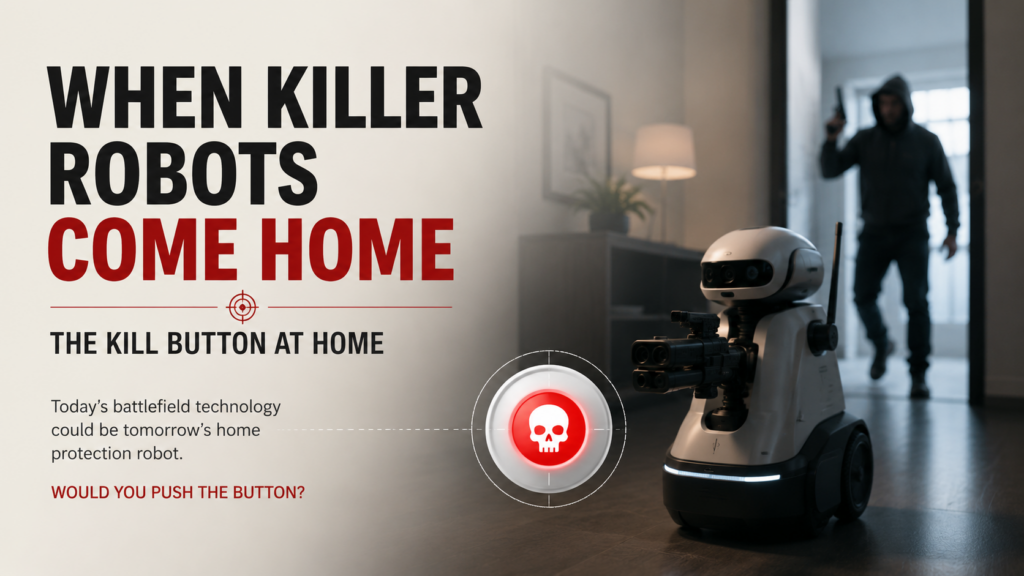
Pause for a second about the ethics of deploying killer robots on the battlefield to ask yourself: Would I push the kill button on my home protection robot as the intruder aims his gun at my family?
Nothing like that is on the market. Legislation in most countries prohibits their development. And for most of us, the killing fields of Ukraine are far away, allowing us to turn our thoughts to the rights and wrongs of matters closer to home.
Yet big industry abhors a vacuum, perhaps even more than nature does. Electricity and cars, home computers, and more recently, civilian drones — all were once considered threatening or immoral. Then, market demand gradually eroded our fears. We decried surveillance tools like facial recognition as dystopian just a few years ago. Now we use it to log onto our laptops and glide through airports. By that logic, today’s horrifying idea of armed homedefense robots may be tomorrow’s Doberman attack dog.
So when? In five years? Ten?
Knightscope, Cobalt Robotics, Ubtech, Ring/Amazon, and several startups are actively developing or testing autonomous or semiautonomous homesecurity robots. Their functions are restricted to surveillance and early warning. But Ukraine’s success in “clean” kills of Russian soldiers shows that the technology is there. And America, where more than 50 million households have a gun, is a market in waiting.
Strong moral opposition stands in the way, for now. Pope Leo last month argued that any technology that kills “without seeing the face of human beings” lowers the moral threshold and risks detaching human responsibility from killing. Philosopher Wendell Wallach has spoken of a future with “automated lethal guardians” for the rich. Tech critic Cory Doctorow warns, “If you can buy a robot vacuum, you can buy a robot that kills. The only question is when someone decides to sell you one.” AIethics scholar Peter Asaro has argued that armed domestic robots would create “a privatized, unregulated battlefield inside civilian life,” collapsing the distinction between war and home.
Even mainstream analysts have voiced unease. A RAND Corporation researcher noted at a 2024 panel that “The first armed home robot will not be built because someone wanted it. It will be built because someone feared not having it.
But powerful figures already see killer robots as the future, at least in war. US Defense Secretary Pete Hegseth has repeatedly argued in favor of expanding autonomous weapons, framing them as necessary tools for maintaining U.S. military superiority. He is supported by Robert Work, Paul Scharre, Christian Brose, and other influential defense experts in the US who insist America must embrace autonomous lethal systems to stay ahead of China.
None has mentioned transferring such technology to protect homes, and why should they? Their concern is keeping America ahead on coming battlefields. But in our lifetimes, computers moved from military codebreaking to the home den, drones from classified reconnaissance to Amazon deliveries, and facial recognition from intelligence agencies to unlocking our phones.
All were feared at first. See the pattern?
Which brings me back to my first question. And even if you oppose killer robots, I know your answer.
You can find more of my writing and reporting here:
Instagram | TikTok | Muck Rack | Thoughts