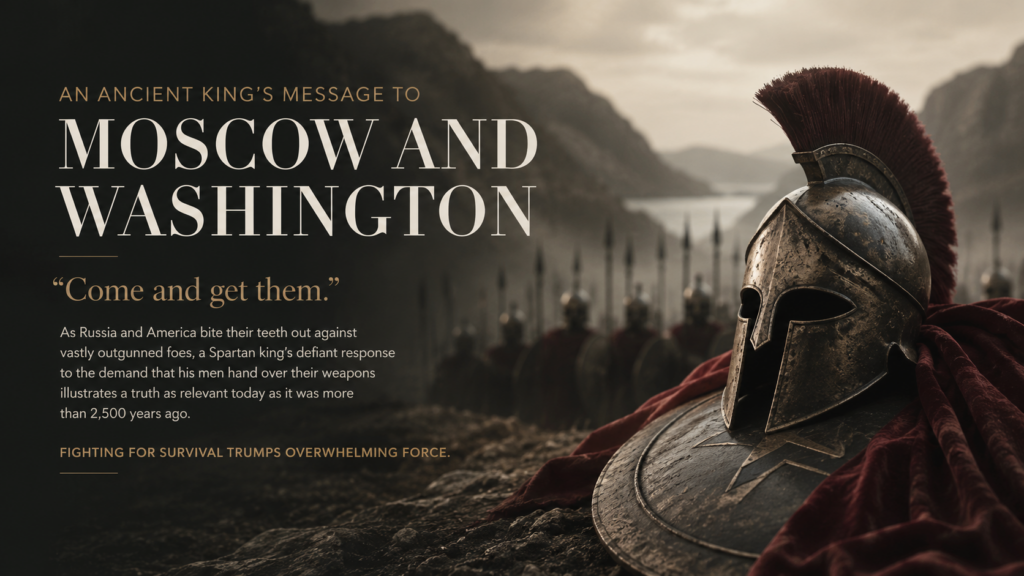
“Come and get them.”
As Russia and America bite their teeth out against vastly outgunned foes, a Spartan
king’s defiant response to the demand that his men hand over their weapons illustrates a
truth as relevant today as it was more than 2,500 years ago.
Fighting for survival trumps overwhelming force.
Consider Thermopylae. Under King Leonidas I, roughly 7,000 Greek defenders held off
the invading forces of King Xerxes I, whose army may have reached 300,000. By any
conventional measure, the Greeks should have been swept aside. Yet the narrow
terrain, combined with the defenders’ absolute commitment to protecting their homeland,
neutralized Persian superiority. The Greeks fought with the purpose of people who knew
defeat meant the destruction of their world.
Sure, they were overwhelmed in seven days. But that in itself was a heroic act against a
force that may have outnumbered them 43 times. And who knows what the outcome
might have been had one of their own not betrayed them by leading the Persians onto a
secret pathway that allowed them to attack the defenders of the pass from the rear.
Ukraine’s resistance against Russia proves the point closer to our time. So does Iran’s
against the US. Both have essentially fought a big power to a standstill, Kyiv after 4
years of full-fledged war and Tehran more than four months into the most recent round
of hostilities.
Both face a larger and better-equipped adversary. But Ukraine’s defenders are fighting
for sovereignty and their national identity against Russian forces widely described as
poorly motivated and unclear about why they’re there. And, if anything, the U.S. attacks
may have strengthened popular support for Tehran’s Islamic leadership, which was
widely opposed by much of the population before the first missile landed. That would
have helped its focus on asymmetric tactics while waiting out the inevitable growth in
U.S. public opposition to the war now pushing the White House toward negotiations with
many of its initial objectives unmet.
One man’s betrayal led to the Greeks’ defeat. But a nation contemplating an attack on
another’s home territory would do well to remember both Thermopylae and Afghanistan.
Today, they may have bigger missiles. But maybe not big enough to turn the fight in their
favor against those defending their homes and identities.
And there are no secret paths to turn the odds in their favor.
You can find more of my writing and reporting here:
Instagram | TikTok | Muck Rack | Thoughts | Substack