We’ve all heard the argument: The world is in chaos like never before. But we’re all
going to survive this. Things will return to a predictable order. Future US presidents will
act rationally, and with it, the sort of global balance marked by stable international trade
rules and respect for borders in place since the end of World War II will magically
reappear. Power grabs, like Russia’s invasion of Ukraine, will become a shameful
historical anomaly, and the threats from the White House to annex other countries will be
treated as nothing more than the outrageous bluffs they were.
Some of my more starry-eyed friends even fantasize that the United Nations will finally
come into its own as the post-World War II institution it was meant to be — a place for
seeking consensus after the shock of COVID, the greatest conflict since that war,
climate change, refugee crises, AI, and on and on.
But what if disorder is here to stay?
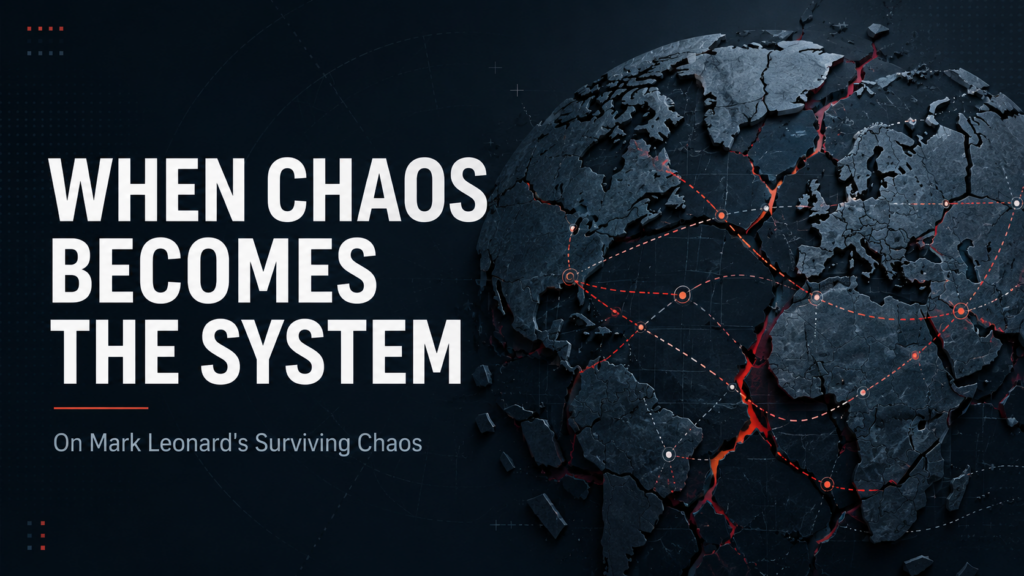
Read Mark Leonard’s Surviving Chaos: Geopolitics When the Rules Fail.
Leonard, the director of the European Council on Foreign Relations, advises us to brace
ourselves for the permanent collapse of the rules-based global order into an era of “Un-
Order.” While Western nations are the “architects” trying in vain to rebuild the rules-
based global order, the “artisans,” exemplified by China, improvise and adapt to the
world as it now is, in permanent chaotic flux.
Leonard cites the paralysis of the UN Security Council by great-power vetoes, the
collapse of the World Trade Organization’s dispute-settlement system, and the failure of
climate negotiations as organizations or agreements that no longer function in a
multipolar world. He is a champion of the democratic values enshrined in the European
Union. But he argues that the best way to defend them is not by looking back but by
adapting to the new agility and leaning into change, instead of opposing it. Supply
chains are being rebuilt around security, not efficiency; free trade has been replaced by
industrial policy; and global coalitions are making way for regional blocs. The book urges
policymakers—especially in Europe—to stop defending a dying system and instead
learn to operate effectively within chaos.
An unsettling but well-supported wakeup call. And one with a short window.
You can find more of my writing and reporting here:
Instagram | TikTok | Muck Rack | Thoughts